(Reported by Siqi Hu) To build a high-level academic exchange platform, broaden the intellectual horizons of faculty and students, and spark enthusiasm for scientific innovation, the School of Materials Science and Engineering invited Professor Shilie Pan, Director of the Xinjiang Technical Institute of Physics and Chemistry, Chinese Academy of Sciences, and a recipient of the National Science Fund for Distinguished Young Scholars, to be a guest speaker at the Materials Forum on May 27. Professor Pan delivered an enthralling lecture entitled "The Creation of Vacuum Ultraviolet Optoelectronic Functional Crystals" and later held a discussion session with representatives of the school's young faculty members. The lecture took place in Lecture Hall A326 of the School and was moderated by Professor Hongyang Zhao, Vice Dean of the School and Director of the Hubei Key Laboratory of Plasma Chemistry and Advanced Materials.
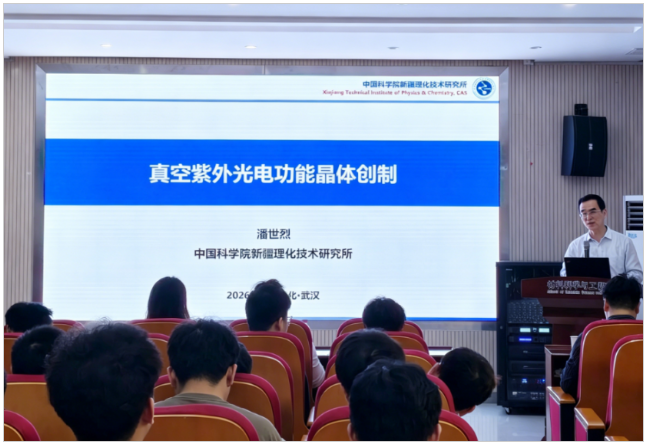
Professor Shilie Pan shared a fascinating academic talk with the faculty and students
In his lecture, Professor Shilie Pan began by highlighting that nonlinear optical crystals serve as a vital material foundation for laser technology, and went on to expound on their strategic supporting role in cutting-edge scientific research. He zeroed in on the core scientific issue of "balancing key performance parameters such as band gap, nonlinear optical coefficient, and birefringence during crystal preparation." He then systematically presented the landmark achievements his research team has made in pioneering original innovations and breakthroughs in crystal growth technologies, as well as in achieving self-reliance and full control over optoelectronic functional crystal materials for critical laser technologies.
Professor Pan went on to introduce the composition of his research team, the development of their scientific platforms, and the group's representative achievements in recent years, expressing his heartfelt gratitude to his team members for their long-standing dedication and outstanding contributions. A lively discussion then ensued between Professor Pan and the faculty and students in attendance, centered on the topics covered in the lecture. He warmly welcomed those present to visit the Xinjiang Technical Institute of Physics and Chemistry, Chinese Academy of Sciences, for future exchanges and study, with the shared goal of advancing the field of optoelectronic functional crystal materials.
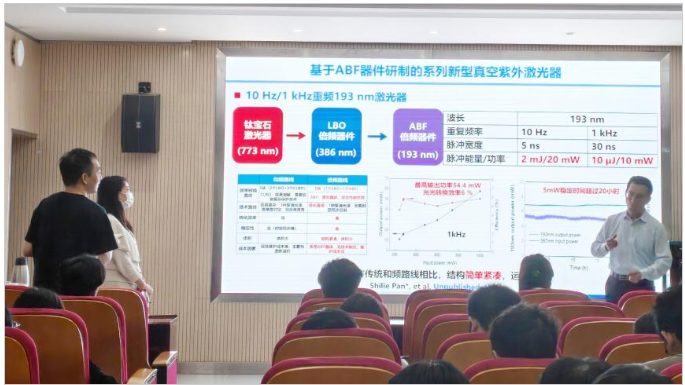
The faculty and students engaged in a lively academic exchange and discussion with Professor Shilie Pan.
The symposium was chaired by Jiayou Ji, Director of the Party Committee Talent Affairs Office. Attendees included Professor Shilie Pan, Professor Tingting Jia from Hubei University, Junjie Liu, a representative of young faculty members from the School of Materials Science and Engineering, and other faculty and student representatives from the school. The two sides engaged in in-depth discussions on frontier scientific issues, key technological breakthroughs, and future development trends surrounding vacuum ultraviolet optoelectronic functional crystals. Drawing on the research blueprint of the Xinjiang Technical Institute of Physics and Chemistry, Chinese Academy of Sciences, Professor Pan and the school's faculty reached a consensus on potential areas of collaboration, including the joint cultivation of high-level talent, coordinated project research, and the sharing of platform resources.
The lecture and symposium not only gave the faculty and students a deeper insight into the frontier advances in vacuum ultraviolet optoelectronic functional crystals, but also built a bridge for them to exchange ideas with and learn from top-tier scholars. It is of great significance in advancing scientific innovation, talent development, and academic collaboration within the school's materials science discipline.
About the Speaker:
Shilie Pan is a recipient of the National Science Fund for Distinguished Young Scholars, a Leading Talent of the National Ten Thousand Talents Program, a Young and Middle-aged Science and Technology Innovation Leading Talent of the Ministry of Science and Technology, and a Fellow of the Royal Society of Chemistry. He serves as Director of the Xinjiang Technical Institute of Physics and Chemistry, Chinese Academy of Sciences, and Director of the Key Laboratory of Functional Materials and Devices for Special Environments, CAS. He has published over 700 SCI papers in journals such as Nature, Nature Photonics, and Nature Communications, and currently serves as Associate Editor of Journal of Synthetic Crystals and Laser & Optoelectronics Progress, as well as an editorial board member for international journals including The Innovation, Science China Materials, eScience, and iDEA, and for Chinese journals such as Chinese Journal of Structural Chemistry, Journal of the Chinese Ceramic Society, and Progress in Chemistry. For many years, he has devoted himself to fundamental and application-oriented basic research on optoelectronic functional crystal materials, making groundbreaking contributions to the creation of multi-band and multifunctional optoelectronic functional crystal materials. The high-performance deep-ultraviolet nonlinear optical crystals he created, such as ABF, have set world records for the shortest output wavelength, the highest output energy, and the highest conversion efficiency, providing a strategic material safeguard for China's integrated circuits and other critical fields.