(Reported by Danfeng Zhou) Recently, Associate Professor Chu Yao from the School of Materials Science and Engineering at Wuhan Institute of Technology has made significant progress in the field of electromagnetic interference (EMI) shielding composites. The findings were published in the prestigious international journal Advanced Functional Materials (IF: 19) under the title "Sandwich Structural Hollow Glass Microspheres/Organosilicone Composite for High-Performance Electromagnetic Interference Shielding with Ultra-Low Conductivity." The study proposes a universal design strategy that couples a microcapacitor network with a macroscopic sandwich structure, enabling highly efficient EMI shielding in the composite while maintaining ultra-low conductivity. This work provides a new route for the design and development of multifunctional integrated protective materials.
Our university is the sole corresponding institution for the paper. Associate Professor Chu Yao, Dr. Chenjian Li, and Dr. Danfeng Zhou are listed as co-corresponding authors, and Xinyi Ju, a master's student at the School of Materials Science and Engineering, is the first author.
With the growing ubiquity and tight integration of electronic devices, severe electromagnetic pollution has made it imperative to develop highly efficient electromagnetic interference (EMI) shielding materials. Yet, conventional EMI shielding materials rely heavily on the addition of large quantities of conductive fillers to boost electrical conductivity—an approach that can readily lead to short circuits and overheating in densely packed electronics, while the strong reflection of electromagnetic waves by highly conductive materials also causes secondary pollution. As a result, achieving excellent absorption-dominated EMI shielding effectiveness under low-conductivity conditions remains a crucial challenge in moving this field forward.
To address these challenges, the research team put forward an entirely new design concept: constructing a high-density microcapacitor network inside the composite system, synergistically coupled with a sandwich structure, thereby circumventing the limitations of conventional conductive networks. The team successfully built a microcapacitor architecture using conductive hollow glass microspheres@Ag@polydopamine (HAP) as the electrodes and insulating organosilicone (OSi) as the dielectric. It was found that the conductive HAP particles were uniformly dispersed and isolated from one another within the OSi matrix, forming a dense microcapacitor network. Under an electromagnetic field, induced currents are generated through electron oscillation, which significantly enhances polarization and the dissipation of electromagnetic waves. Extending this design strategy further, the team integrated polyimide/carbon nanotube porous aerogel (PCA) onto both the top and bottom surfaces of the composite, creating a sandwich-structured PCA-HAP/OSi-PCA composite. The composite polyimide aerogel layers on the surfaces of the sandwich structure improve the overall impedance matching of the material. Through the synergistic effect of these mechanisms, the risks of secondary pollution and short circuits associated with traditional highly conductive composites are fundamentally avoided.
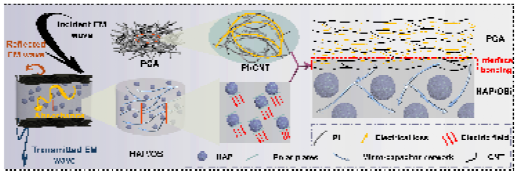
The research team validated this mechanism through electromagnetic parameter analysis and finite-element electric field simulations. With a filler loading of only 8 wt.%, the HAP/OSi composite achieved an outstanding EMI shielding effectiveness of 45 dB at an ultra-low conductivity of 0.0435 S/m. Thanks to the synergy between the layered aerogel and the microcapacitor network, the sandwich-structured PCA-HAP/OSi-PCA composite further elevates the shielding effectiveness to a superior 60 dB at an extremely low conductivity of 0.0501 S/m, while delivering an absorption coefficient of 0.8. Beyond that, the material demonstrates an impressive sound insulation performance of up to 52.8 dB, excellent thermal conductivity of 0.5854 W/mK, and remarkable thermomechanical stability across an ultra-wide temperature range from –196 °C to 200 °C. Offering integrated protection against electromagnetic, acoustic, and thermal threats, it also extends the material's applicability to extreme environments and holds great promise for real-world industrial adoption.
Xinyi Ju is an outstanding student cultivated entirely through our university's own undergraduate and master's programs. She has long focused on the design and surface-interface engineering of multifunctional composites. During her time at the university, she published two papers as first author in top-tier CAS Zone 1 journals and one paper in a CAS Zone 2 journal, and was awarded the National Scholarship for Graduate Students. The research findings published in Advanced Functional Materials under the supervision of Associate Professor Chu Yao represent yet another major breakthrough in her master's-level research. Building on her impressive research achievements and solid academic foundation, Xinyi Ju will soon continue her studies at a higher-level institution to pursue a doctoral degree.
This paper also marks yet another high-impact journal publication from our university's Functional and Environmental Polymer Materials Research Group. Looking ahead, the group will further concentrate on key scientific challenges in the integrated protection of highly integrated electronic devices, accelerate the translation of fundamental research outcomes into practical applications, effectively address issues such as electromagnetic interference, heat accumulation, and acoustic pollution, and continue to serve the critical needs of national strategic development.